
Recent Entries
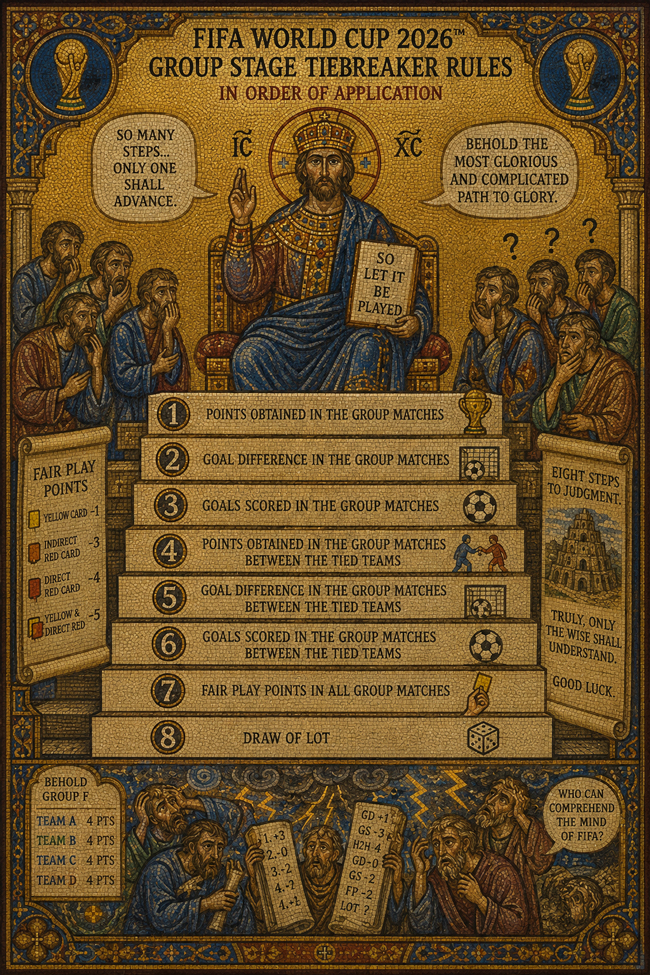 | |
 | Group Tiebreaker Rules - Do you understand them? Posted by |
Below is a recap of the Group Play/Standings tiebreakers. They are not what you (or at least I) expected. When I tried to create the bracket play format and the bracket itself I had to yell at the AI a lot and tell Claude he was wrong. He was wrong at times, but it has changed. Enjoy? 
2026 World Cup Group Stage Tiebreakers
The Big Change: Head-to-Head Comes First
The new tiebreaker rule switches the within-group first tiebreaker from goal differential to head-to-head results. Goal differential, which used to be the first separator, is now the second tiebreaker.
Many fans assume overall goal difference is the top criteria — it isn't anymore. Head-to-head mini-table results come first.
The Full Tiebreaker Ladder
Phase 1 — Head-to-Head Among Tied Teams (applied first):
The first set of criteria focuses on matches played exclusively between the tied teams:
- Most points in head-to-head matches
- Superior goal difference in those head-to-head matches
- Most goals scored in those head-to-head matches
Phase 2 — If Still Tied, Look at All Group Matches:
- Superior goal difference in all group matches
- Most goals scored in all group matches
- Highest team conduct (fair-play) score — fewest yellow/red cards
- FIFA World Ranking
Last Resort: A drawing of lots, organized by FIFA. It's extremely rare — but it has happened. At the 1990 World Cup, the Republic of Ireland and the Netherlands finished level on every count and were separated by a draw of lots.
The Fair-Play Score Explained
FIFA's fair-play system assigns a negative value to each card: a single yellow = −1, a second yellow leading to a red = −3, a direct red = −4, and a yellow followed by a direct red = −5. The team with the smaller total deduction wins the tie. This isn't just theoretical — at the 2018 World Cup, Japan advanced over Senegal on fair play: both were level on points, goal difference, goals, and head-to-head, but Japan had fewer cards (−4 against Senegal's −6).
The Brutal Side Effect
The new rule means it's now very possible for a team to clinch a group after just two matches. Mexico has already done it — after beating South Africa on Matchday 1 and South Korea on Matchday 2, Mexico holds the head-to-head tiebreaker advantage and can't be displaced from first regardless of the final game result.
This greatly impacts Matchday 3: a group's top team, with nothing to play for, may rest all its key players — giving a lesser opponent a much better chance of winning than they'd have faced against the full-strength squad.
Qualifying as a Third-Place Team
Since 8 of 12 third-place finishers advance, there's a separate ranking for those teams. To identify the top eight third-placed teams, FIFA uses: points, best goal difference, most goals scored, best disciplinary record, and finally FIFA ranking. Note there's no head-to-head component here since those teams never played each other.
So yeah — the head-to-head-first rule sounds sensible in isolation, but the "clinch after two games and tank Matchday 3" dynamic is a real and potentially ugly consequence. FIFA is essentially recreating a version of the problem they were trying to solve.
Readers Comments
Did all y'all know about these new tiebreakers?


Never count FIFA out when it comes to making bad decisions.

The head to head record does make some sense, but it has created the perverse situtation where teams are already out. It does avoid the possibility of a drubbing through a couple of sendings off not completely ruining your chances though.
My biggest issue is the 48 team format. 72 games to eliminate just 16 teams. Nearly 70 % of the games.
And added in the lack of jeopardy for the big teams (although Belgium are doing their very best to disprove that). It is also making the games more negative I think. 3 draws is likely to see you through, so it has been defence first.